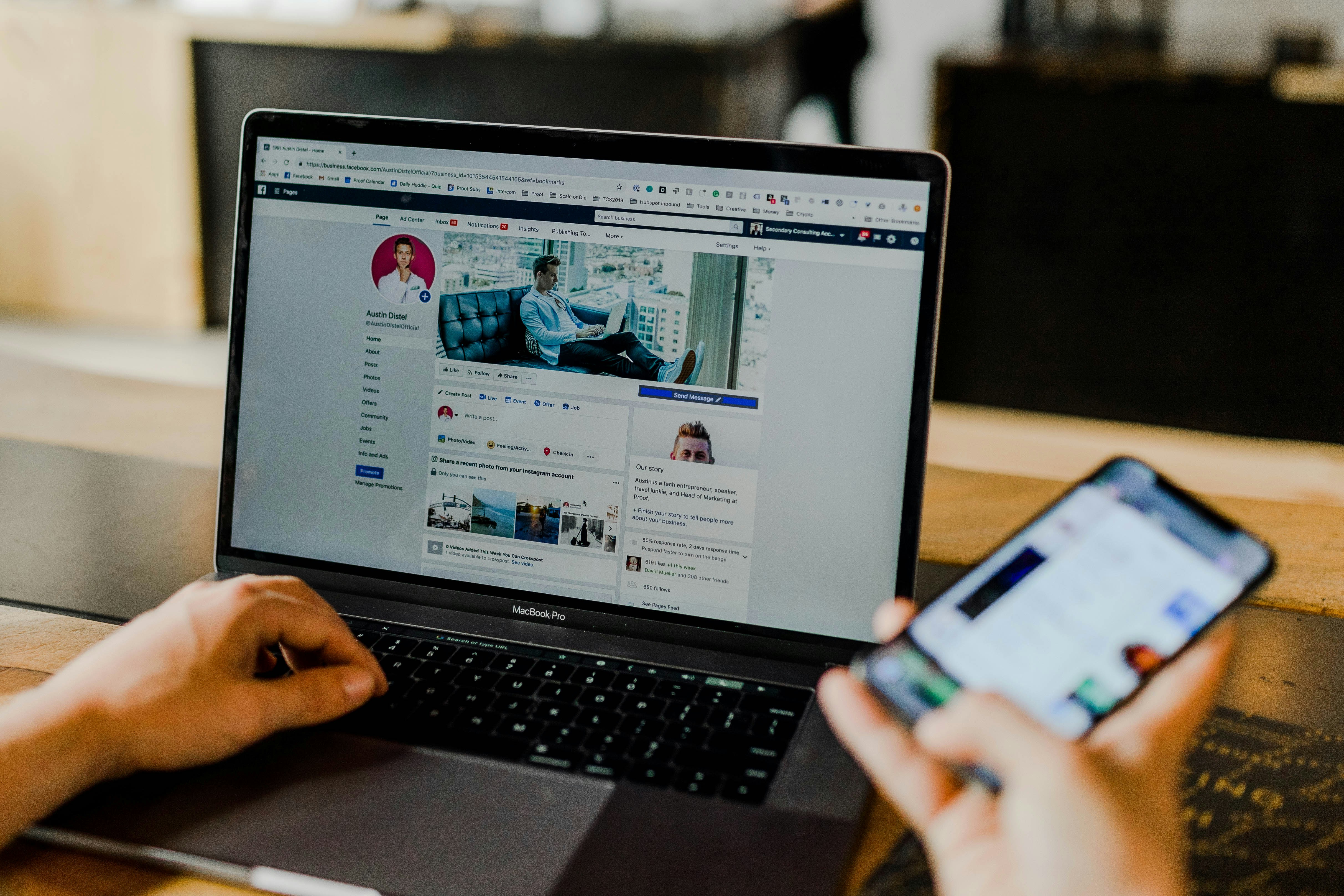
Many businesses still think: "I have a Facebook page, so I'm covered online." In 2026 it's the exact opposite: relying only on Facebook means having no control over your digital business and depending on a platform that can change the rules overnight.linkedin ↗
In this article, we'll look simply at why a Facebook page alone is no longer enough and why you need a website as your real "home" online.
- Algorithms decide who sees you
- You don't have control: the page isn't really "yours"
- Facebook doesn't help you rank on Google
- Trust and credibility
- On Facebook you're surrounded by distractions
- Your website as a "home" for all your channels
- Facebook + website: making them work together
- In practice: if you only have a Facebook page today
Algorithms decide who sees you (and usually very few do)
In recent years, the free visibility of business page posts has plummeted: today most pages see an average organic reach of about 1–5% of their followers.kirkgroup ↗In plain terms: if you have 1,000 followers, your posts are often shown to just a few dozen users, unless you pay for advertising.campaignpros ↗
This means:
- You can't decide who sees your content: you depend on the algorithm.
- Any rule change can make you lose visibility overnight, with little you can do about it.getresponse ↗
With a website, people find you through Google, direct searches, or links from other channels — you're not tied to the whims of any algorithm.mozello ↗
You don't have control: the page isn't really "yours"
A Facebook page lives on someone else's land: the rules, the layout, and how your content is displayed are all decided by Meta, not you.linkedin ↗In extreme cases, your account can be restricted or blocked ("Facebook jail"), and you can find yourself without access to your content or followers, even if you did nothing wrong.geoffresh ↗
A website, on the other hand:
- Has your own domain (e.g., yourbrand.com), building recognition and identity.newperspectivestudio ↗
- Is a space you control 100%: structure, content, design, contact methods.deltadigital ↗
- Doesn't disappear because a platform decides to change its rules or shut down a service.
Facebook can change, decline, or lose users (as has happened with other platforms in the past): your website remains the fixed point that doesn't depend on trends.geoffresh ↗
Facebook doesn't help you rank on Google
When someone searches Google for "psychologist + city," "urgent plumber + city," or "shop [product] + city," Google tends to show websites and Google Business profiles as the main results.mozello ↗A simple Facebook page rarely ranks well for many different searches, especially if it's not linked to a website and a well-maintained search engine presence.quzeks ↗
A website:
- Can be optimized for multiple keywords related to your services and your area.
- Allows you to create specific pages (e.g., one service for each client problem) that Google can show as precise answers to searches.mappersgeo ↗
Bottom line: if you rely only on Facebook, a huge portion of people searching for you on Google may never find you.
Want to see if your local ranking on Google is correct? Request a free analysis of your online presence →
Trust and credibility: having only Facebook makes you look less serious
Anyone can open a Facebook page in 5 minutes, add a logo from the internet, and write two lines — even someone who isn't a real business.getresponse ↗That's why more and more people use the official website as "proof" that a business truly exists and operates professionally.newperspectivestudio ↗
Recent research shows that:
- A large percentage of users judge a business's credibility by the quality of its website; the absence of a website or a very poor one raises suspicion.mozello ↗
- Up to 90% of people research online before buying: without a website, you often don't even make it onto their shortlist.marketingltb ↗
A well-crafted website with clear information, contacts, reviews, and perhaps a blog instantly makes a more serious impression than a social page that anyone can update in minutes.quzeks ↗
On Facebook you're surrounded by distractions and competitors
Anyone who sees you on Facebook sees you alongside:
- Posts from friends and family.
- Videos, memes, news, ads from other companies.
- Content recommended by the algorithm to keep them on the platform.deltadigital ↗
So even when someone visits your page, it takes just a moment for them to leave and get distracted by something else. On your website, you have the user's attention for those crucial few seconds when they might decide to contact you, book, or request a quote.deltadigital ↗
Plus, on Facebook, competitor pages or ads can appear right next to yours, while on your website you're the only voice, on your own terms.geoffresh ↗
Your website as a "home" for all your channels
Your website is the center of your entire online presence: a "home" where you drive traffic from Facebook, Instagram, Google, email, ads, flyers, and business cards.mozello ↗Social media, on the other hand, are like "town squares" where you go to talk to people and then invite them to visit your home.
On your website you can:
- Present in an organized way services, prices, portfolio, case studies, reviews, FAQs.webador ↗
- Set up contact forms, booking systems, e-commerce, blog, newsletter: tools that are limited or non-existent on social media.newperspectivestudio ↗
- Deeply measure what's happening (with tools like Google Analytics) and improve your pages over time.geoffresh ↗
Facebook remains incredibly useful for building awareness and communicating quickly; the website is where you turn that attention into real clients.
I design and build independent websites, fully integrated with your social media channels. Discover how I work →
Facebook + website: making them work together
The solution isn't to "abandon Facebook," but to stop using it as your only channel. The winning mix in 2026 is:
| Channel | Role | What to Do |
|---|---|---|
| Website (foundation) | Digital home, conversion point | Professional presentation, clear info, tools for contact, booking, and purchase. |
| Facebook (support) | Communication square | News, offers, behind-the-scenes; reply to messages; clear links to the site ("learn more," "book on the site"). |
This way you don't put "all your eggs in one basket": if the algorithm changes one day, your content and contacts remain safe on your website.
In practice: if you only have a Facebook page today
If you only have a Facebook page today, it means:
- You don't truly own your online space.
- You depend on the rules, algorithm changes, and limitations of a third-party platform.
- You project a less solid image compared to those with a well-made website connected to social media.linkedin ↗
The natural next step is to build a simple but professional website that becomes your online home, and use Facebook (and other social media) to bring people there. This way, instead of constantly chasing the algorithm, you build a solid, credible digital presence that's under your control.getresponse ↗
FAQ - Frequently Asked Questions on Website vs Facebook
- Why is a Facebook page not enough to get found on Google?
- Because Google prefers to index and show structured websites and Google Business Profile listings for local searches (e.g., "plumber Bari"). Facebook pages rarely appear in top local search results.
- What are the risks of relying only on social media for my business?
- The main risk is loss of control: if the platform changes its algorithm, you lose organic reach. Also, Meta owns your data and followers; if your account gets hacked or suspended, you lose customer contact.
- How should a website and Facebook work together?
- Facebook should serve as a town square to grab user attention and build community, while your website is the "digital home" where you direct users to convert them into clients or bookings.